


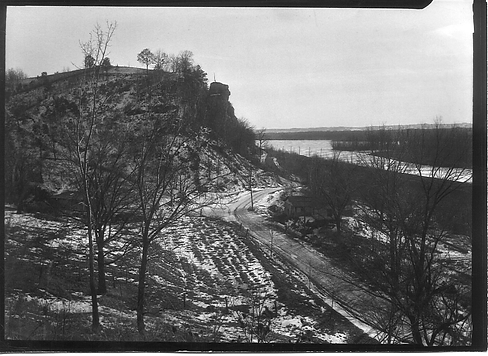
Savanna is Born
After the Black Hawk War ended in 1833, settlers returned from Galena and Savanna began to take shape. Vance Davidson and Aaron Pierce each built two-story log homes overlooking the Mississippi River, while earlier cabins were repurposed for kitchens and lodging. As the only stopping point between Rock Island and Galena, Savanna quickly became a busy rest stop for travelers arriving by foot, horseback, and steamboat.
One such arrival was Luther Bowen, a young surveyor from New York. Seeing the potential of the settlement, Bowen negotiated with the original settlers to purchase land, returning in 1835 to formally lay out the town with his partner, Murray. They named it Savanna, a reference to the open prairie south of town. Cornfields soon became streets and lots, with Main Street and Commerce Street forming the heart of early development.
Savanna’s first marriage took place on June 11, 1835, when Harriet Pierce married Vance Davidson. That same year, Bowen began expanding the settlement—building a hotel, opening a general store, establishing a post office in 1836, and serving as Savanna’s first postmaster. He also constructed the town’s first frame house. Industry followed quickly. The Bowen brothers built a sawmill on the Plum River, supplying lumber for the growing town. A powder mill soon followed, serving the Galena mines. Aaron Pierce built a hotel that would later be known as the Chambers House, while Vance Davidson operated a riverfront store and warehouse supplying goods and cordwood to passing steamboats.
By the late 1830s, Savanna had doctors, brickmakers, merchants, and multiple general stores. Native brick was used to construct the town’s first brick buildings, signaling permanence and growth. In 1839, Savanna was named the first county seat of newly formed Carroll County, though the designation later moved to Mount Carroll. Despite this setback, Savanna continued to thrive—firmly established as a river town shaped by trade, travel, and determination along the Mississippi.

Early Settlers
Savanna’s story begins in the early 1800s with the Pierce family. Aaron Pierce and his wife Harriet (née Bellows) married in Boston and gradually moved west, settling briefly in New York before relocating to Illinois in 1825. There they joined fellow pioneer families George Davidson and William Blundell, eventually heading north toward Galena after hearing of lead mining opportunities.
Unimpressed with mining, the group instead followed the Mississippi River south to a “beautiful valley” previously noted by Vance Davidson. Traveling by covered wagon along an old Indian trail, they reached the area now known as Savanna on November 4, 1828, taking shelter in an abandoned wigwam near today’s Pioneer Monument. Soon after, the other families arrived by boat.
The settlers cleared land and built log cabins from walnut trees near what is now the north end of Main Street. By Christmas, the cabins were complete. The following spring, the pioneers focused on farming and cutting cordwood to sell to passing steamboats, an early economic foundation for the settlement. Crops flourished, wild berries, nuts, and honey were abundant, and grain was ground at nearby Craig’s Mill.
On May 8, 1829, Mary Jane Pierce was born—the first white child in the settlement and in Carroll County. That same year, additional settlers staked claims in the area, further establishing the community.
Native American tribes were frequent visitors and largely peaceful, often camping near present-day Marquette Park. Though daily life was challenging—with no stoves, matches, or modern lighting—the settlers relied on ingenuity, nearby springs, and one another to survive. From these humble beginnings, Savanna took root along the Mississippi River.

Savanna Newspapers
Savanna’s newspaper history began in 1854 when Charles Allen and Smith Atkins founded The Register. After a short run, the paper was sold and moved elsewhere.
In 1875, The Savanna Times was established by J. William Mastin and Simon Greenleaf. The first issue printed in Savanna appeared on September 11, 1875. Greenleaf later became sole owner and editor, guiding the paper through much of its early growth.
In 1885, Frank Greenleaf, Simon’s son, founded The Savanna Journal, the county’s only Democratic newspaper, which later became the Savanna Daily Journal. On September 29, 1917, the merger of the Savanna Times and the Savanna Daily Journal was announced. The first issue of the Savanna Times Journal was published on October 1, 1917, under Frank Greenleaf’s ownership, with a declared non-partisan stance.
Ownership changed hands several times throughout the 20th century, reflecting shifts in journalism and technology. The paper evolved from a daily to a biweekly and eventually a weekly community newspaper. An advertising shopper, the Northwestern Illinois Dispatch, was also published for several years before being discontinued.
Today, the Savanna Times Journal continues as a weekly publication, owned by Robert Watson, with its office located at 315 Main Street—carrying forward more than a century and a half of local journalism in Savanna.


Opera House Murders
Daniel S. Berry (1858–1905) was one of Savanna’s most prominent citizens. Born in Sterling, Illinois, he worked his way through school, became a teacher, and later pursued law. Admitted to the Illinois bar in 1882, Berry moved to Savanna in 1883, where he quickly built a respected legal career. He served as Savanna City Attorney, president of the School Board, legal counsel for local railroads, and represented Illinois’ 12th District in the state legislature from 1891 to 1897.
Despite professional success, Berry’s legislative career ended amid political controversy—charges he consistently denied. Nevertheless, he remained a leading figure in Savanna’s civic and legal life.
On the morning of May 22, 1905, Berry was shot and killed outside his law office in the Opera House building on Main Street. The crime shocked the community. The assailant was never definitively identified, and the case remained shrouded in mystery despite an extensive investigation.
Just three days later, on May 25, 1905, Bothwell “Bot” Pulford, a wealthy Savanna businessman and owner of the Opera House, took his own life in his barn. Pulford had become the subject of public suspicion following Berry’s murder, though he was never formally charged. His death deepened the town’s grief and speculation.
Pulford was widely known as a successful entrepreneur, owning much of the 300 block of East Main Street, numerous residences, and the city’s electric light plant. Remembered as generous, shrewd, and intensely private, his suicide was officially ruled the result of “melancholic collapse.”
Both funerals drew massive crowds and left Savanna shaken. The events of May 1905 marked one of the most tragic and emotionally charged chapters in the city’s history—one that resonated deeply through the community for years afterward.

Plum River Raid
Chief Black Hawk of the Sac and Fox tribes claimed much of western Illinois and Wisconsin under an 1804 treaty and resisted government orders to relocate west of the Mississippi River. Rising tensions led to the Black Hawk War (1831–1833), prompting settlers throughout the Mississippi Valley to prepare for possible conflict.
In the spring of 1832, Savanna settlers built a blockhouse between the Davidson and Pierce cabins as a refuge for women and children. After receiving warnings from Fort Armstrong, settlers temporarily fled to Galena. When they returned, fears subsided—until May 21, 1832, during what became known as the Plum River Raid.
A small group of Native warriors attacked the settlement, firing on the blockhouse, destroying crops, killing livestock, and attempting to disable the settlers’ boats. Though no settlers were killed, the attack forced the remaining men to flee by skiff to Galena under cover of darkness. The settlement was left abandoned.
The raid was later determined to be an isolated incident, not an organized action of the Black Hawk War. The settlers remained in Galena until the conflict ended in 1833, after which they returned to Savanna. With peace restored, the community quickly resumed growth and development.
Early Settlers
Savanna’s story begins in the early 1800s with the Pierce family. Aaron Pierce and his wife Harriet (née Bellows) married in Boston and gradually moved west, settling briefly in New York before relocating to Illinois in 1825. There they joined fellow pioneer families George Davidson and William Blundell, eventually heading north toward Galena after hearing of lead mining opportunities.
Unimpressed with mining, the group instead followed the Mississippi River south to a “beautiful valley” previously noted by Vance Davidson. Traveling by covered wagon along an old Indian trail, they reached the area now known as Savanna on November 4, 1828, taking shelter in an abandoned wigwam near today’s Pioneer Monument. Soon after, the other families arrived by boat.
The settlers cleared land and built log cabins from walnut trees near what is now the north end of Main Street. By Christmas, the cabins were complete. The following spring, the pioneers focused on farming and cutting cordwood to sell to passing steamboats—an early economic foundation for the settlement. Crops flourished, wild berries, nuts, and honey were abundant, and grain was ground at nearby Craig’s Mill.
On May 8, 1829, Mary Jane Pierce was born—the first white child in the settlement and in Carroll County. That same year, additional settlers staked claims in the area, further establishing the community.
Native American tribes were frequent visitors and largely peaceful, often camping near present-day Marquette Park. Though daily life was challenging—with no stoves, matches, or modern lighting—the settlers relied on ingenuity, nearby springs, and one another to survive. From these humble beginnings, Savanna took root along the Mississippi River.

Rails, River, and Rapid Growth
As Savanna transitioned from a river settlement to a rail-connected city, population, industry, and infrastructure expanded rapidly. Steamboat commerce, railroad development, and local enterprise transformed the town into a regional hub for trade, transportation, and community life along the Mississippi River.

Early Views
An early view of the north end of Savanna.

Early Business
Two early businesses on Savanna’s Main Street were Law’s Pharmacy and A/O Elliott, The Jeweler.

Early Main Street
A view of the east side of the 300 block of Main Street at the turn of the century.

Early Aerial Views
View of Savanna looking south in the mid- 1880s before brick buildings were erected on Main Street.

Population Boom
By 1847, Savanna’s population had reached nearly 500, prompting construction of a stone schoolhouse at Madison and Third Streets. Among the town’s early leaders was Menard Dupuis, a Black Hawk War veteran and Canadian native who became a successful lumberman, Savanna’s first mayor, and a longtime public servant.
Savanna’s first church was built by Methodists in 1849, and the town’s first newspaper, the Savanna Register, soon followed.
For decades, the Mississippi River remained the primary transportation route until rail service arrived. Growth continued with the construction of the Plum River Bridge in 1855 and the designation of Savanna as a terminal for the Racine & Mississippi Railroad in 1857. The town’s first train arrived July 14, 1865, accelerating development.
By 1860, the population had grown to 825, with businesses, homes, churches, and schools spreading along Main and Third Streets. Railroad expansion brought major infrastructure, including roundhouses, depots, and warehouses along Commerce Street. City Hall was built in 1873, and Savanna officially became a chartered city the following year.
One of the most transformative projects was the permanent railroad bridge across the Mississippi, completed in 1880, employing hundreds of workers. By that year, Savanna’s population reached 1,000, and industries expanded to include stockyards, rail mills, ice warehouses, and brewing. The Eagle Brewery, established in 1868, supplied beer throughout northwest Illinois and nearby Iowa.
Prominent businessman Bothwell Pulford emerged as one of Savanna’s largest investors, constructing multiple Main Street buildings, the Pulford Opera House, and the city’s first electric plant. Hotels such as the Occidental (later European) Hotel reflected the town’s growing prosperity.
Education also expanded with the construction of Lincoln School in 1870. By the late 1880s, additional rail lines—including the Burlington—cemented Savanna’s role as a vital rail and river hub, transforming it from a frontier settlement into a thriving Mississippi River city.

1919
A photo of Lincoln School in 1919.

Little Stone School
Savanna's "One Room School"

Lincoln School
Original LIncoln School

Lincoln School
Construction of Lincoln School

1893
Avenue School after the addition in 1893.

1923
Savanna Township High School after the addition in 1923.

Savanna Township
Savanna Township High School after construction in 1902.

Lincoln School
Lincoln School on Third Street.

Savanna Schools
Education in Savanna began soon after the first settlers arrived, reflecting the community’s strong belief in learning. In 1836, Hannah Fuller taught the settlement’s first students—six children—in the Pierce family log home. From that point forward, Savanna has always maintained a school.
As the town grew, classes were held in log homes, frame buildings, churches, and even former courthouses. In 1847, the community achieved a major milestone with the construction of the Little Stone School House at Madison and Third Streets. Serving the town for 44 years, it symbolized Savanna’s commitment to public education. Its original bell, purchased by local women, is now preserved at the Savanna Museum and Cultural Center.
Rapid population growth—especially with the arrival of the railroad—soon made additional schools necessary. New buildings were constructed across town, including schools on Chicago Avenue, Chestnut Park, and the original Lincoln School, built in 1870. A new Lincoln School replaced it in 1929 and served students for more than 70 years.
Savanna Township High School was built in 1901, expanded in 1922, and replaced after a devastating fire in 1957 by a new high school on Longmoor Avenue, completed in 1958.
As enrollment patterns shifted, schools were gradually consolidated. By the late 20th century, declining enrollment led to closures and reorganization. In 2000, a new Chestnut Park School opened on Wacker Road, consolidating kindergarten through eighth grade students.
In 2004, Savanna joined with Mount Carroll and Thomson to form a consolidated district. Today, the former Savanna High School is West Carroll High School, and Chestnut Park serves as West Carroll Primary, continuing nearly two centuries of educational tradition rooted in the city’s earliest days.

Main Street History
Part of the 300 and 400 block of Savanna’s Main Street in 1877, when the town was quickly growing as a busy river and railroad hub along the Mississippi River. Main Street served as the heart of the community — lined with hotels, businesses, gathering halls, and the places where daily life in Savanna unfolded.
The first corner building on the right is the site where Pulford Hall now stands. The building just north of it had quite the journey through town — it was moved south to the corner of Main and Chicago Avenue, later relocated again to the rear lot of the Fulrath Oil Station, and has since been torn down.
The last building visible in the block was the Mississippi House, which later became the Woodruff House, both serving as important hotels during Savanna’s early days when river travelers and railroad workers frequently passed through town. Today, that location is home to the Radke House.
On the left side of the street stood a liberty pole, a common symbol of patriotism in many American towns during the 1800s. Nearby was the Old Town Water Pump, once an essential gathering place where residents collected water and shared the day’s news.
Looking at scenes like this reminds us how Savanna’s Main Street has always been the center of town life — evolving over time, yet still carrying the stories of the people, businesses, and travelers who helped shape this Mississippi River community.

100 BLOCK

200 BLOCK

300 BLOCK

400 BLOCK

500 BLOCK

600 BLOCK

700 BLOCK

800 BLOCK
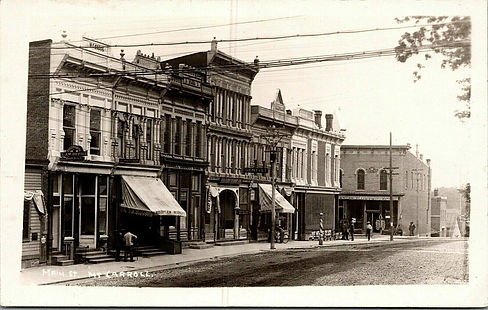
Carroll County History
By the late 1830s, Northwest Illinois was still largely unsettled, with only a few trails winding through the timbered hills. During this time, Savanna was rapidly growing as an important shipping point along the Mississippi River, where packet boats delivered goods and travelers moving through the region.
As more settlers arrived, pioneers found it difficult to travel all the way to Galena to handle legal matters. In 1837, residents petitioned the Illinois State Legislature to separate from Jo Daviess County and form their own county government.
On February 22, 1839, the State Legislature officially created Carroll County, and on April 8, 1839, the first election was held to choose county officers and determine the county seat.
Savanna initially won the vote to serve as the county seat, receiving 126 votes, compared to 86 votes for a site southeast of present-day Mount Carroll. The new county was named Carroll in honor of Charles Carroll of Carrollton, a signer of the Declaration of Independence and one of the wealthiest men in the American colonies.
Early county government was heavily centered in Savanna, with many of the first officials coming from the town. The first courthouse operated in a building at Main and Webster Streets, which also doubled as a schoolhouse and church, reflecting the small but growing pioneer community.
However, as more settlers moved into the eastern part of the county, traveling long distances over rough roads to reach Savanna became difficult. Meanwhile, Savanna had not provided land or funds required to build permanent county buildings.
By 1843, the Illinois Legislature passed an act to relocate the county seat. A commission selected a site near a mill along Carroll Creek, naming the new town Mount Carroll. Later that year, voters approved the move, and county offices were relocated there by September 1844.
The first courthouse in Mount Carroll, built of stone, later burned down in 1872 and was replaced by the courthouse that still stands today.
In 1849, Carroll County adopted a township system, dividing the county into ten townships including Savanna, Mount Carroll, Cherry Grove, Freedom, Woodland, Salem, Lima, Elkhorn Grove, Wysox, and Harlem (later renamed York).
Today, Carroll County continues to serve the communities of northwest Illinois, including the historic river town of Savanna, where the county’s earliest government and legal history first began.